

Shift sets out how to improve the ‘S’ in ESG with new guidance on social indicators /
March 2026
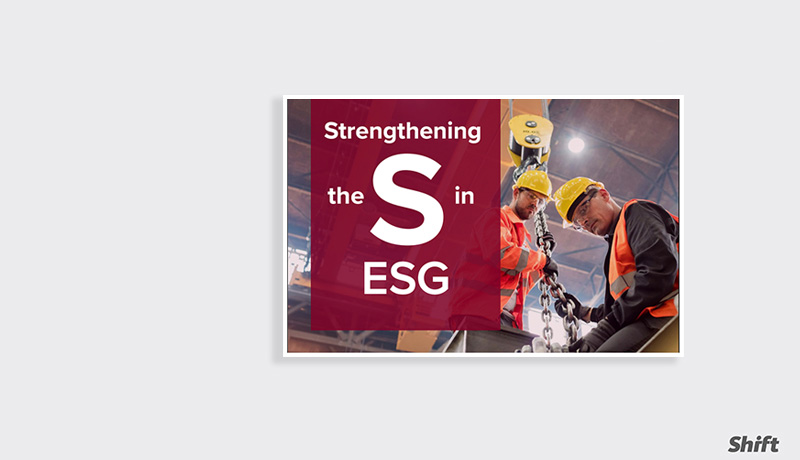
Shift has published guidance on how to measure the effectiveness of steps companies take to address their impacts on society.
Shift, a non-profit working globally to embed respect for human rights into business, analyzed the quality of thousands of social performance indicators used by data firms and standard setters. Social performance covers how companies manage their impacts on people, including their employees, supply chain workers and communities affected by the use of their products or services.
Shift has shared its findings in a research series called “Strengthening the ‘S’ in ESG,” which sets out recommendations for improving the design of indicators.
“There are now thousands of metrics being used to measure social performance. This interest is welcome, but the devil is in the detail. Low quality indicators risk confusing decision makers and can encourage poor behavior by businesses,” said Mark Hodge, the Vice President of Shift.
In the first phase of research, published in Summer 2024, Shift analyzed around 1300 indicators used to assess social performance. This included about 700 social indicators and 225 governance indicators used by five major data firms that measure the environmental, social and governance (ESG) performance of companies. A further 350 social indicators came from standards set by regulators, civil society organisations and others to evaluate and shape business behaviour.
Shift set out six recommendations for improving the design and selection of indicators:
1- Avoid indicators that create perverse behavioral consequences
2- Avoid indicators that encourage unjustified conclusions
3- Avoid indicators that offer insight into a company’s intentions but no insight into whether this is followed through in practice.
4- Use indicators that are strong predictors of business decision-making and behaviour.
5- Focus on indicators that signal the quality of due diligence processes
6- Use indicators that offer insight into a company’s contribution to positive outcomes for people.
For example, Shift recommends avoiding indicators which could encourage poor behavior. Indicators which measure the number of complaints made by staff, for instance, can create incentives for managers to pressure workers into hiding concerns. About 8% of social indicators used by ESG data firms risk encouraging poor behaviour, Shift found.
For the second phase of research, published in October, Shift analysed a further 1,800 social performance indicators which mostly came from benchmarks and standards. Researchers offered recommendations for the design of indicators covering three key areas of social performance: occupational health and safety, living wages and the impact of businesses on communities.
For example, Shift assessed 220 indicators used to measure the health and safety of workers. It found that most focused on past performance data, such as the number of injuries reported over one year. Instead, researchers recommend greater reliance on forward-looking indicators which signal whether firms are thoroughly investigating accidents and taking steps to ensure they do not reoccur.
“This research exposes the good, the bad and the ugly of indicator design,” said Hodge. “We have seen good uptake of our recommendations by investors and even regulators as they turn to the task of evaluating compliance with new legislation.”
Notes:
- The first phase of our research covered indicators in use as of April 2024.
- The second phase of research covered indicators in use as of May 2025.
- We recognize that in some cases data firms could be using methodologies to reach conclusions about a company’s performance against a particular indicator that offers more nuance than we were able to capture in this research.
- Shift included indicators from a wide range of benchmarks and standards in its analysis, including the Global Impact Investing Network IRIS catalogue of metrics, a set of indicators used to measure the social and environmental impact of investments, and ISO 30414, a series of indicators companies use to report on issues affecting their workforce, such as health and safety.