
Financial Institutions /
Advising our partners. Shaping the sector.

- We equip institutional investors, private and public banks, pension funds, export credit agencies and others to build robust due diligence practices.
- We provide financial practitioners with the tools and skills to address people-related risks across challenging sectors and themes.
- We deliver research that demonstrates the connections between impacts on people, risks to business and the systems-level risks that stem from extreme inequalities.
- We produce insights and guidance that accelerate uptake of the responsible practices and shape the standards and regulations that govern the finance sector.
We regularly collaborate with others who share our goals, including the PRI, GRI, UNGC, UNEP FI, and the Equator Principles community.
Why Shift? /
We offer practical, tailored support that works for financial institutions. Our team includes former practitioners from investment, banking and export credit, so we understand the unique realities that our partners face – complex transactions, global portfolios, varying degrees of influence with clients and the pressure to deliver financial as well as sustainability results.
We bring a grounding in real economy practice and challenges. Our work with companies and investees gives us direct insight into what strong social performance looks like, helping financial institutions ask better questions and use their influence with clients more effectively.
Our expertise from our work with standard-setters helps our partners connect their work to the emerging sustainability and corporate accountability rules and regulations.
Our services /

Tailored advisory
We act as a trusted partner – helping financial institutions design and embed practices that work in the real world, whether across large and complex portfolios or to address specific, prioritized impacts and risks. We tailor engagements to meet the needs and tackle the issues of today, taking the time to support the competencies and systems to address what may lie ahead.

Peer networks that move the needle
Shift’s Financial Institutions Circle is a carefully designed space to bring together banks and export credit agencies from around the world. This collegial network of practitioners relies on Shift to facilitate the sharing of common human rights challenges and emerging risk areas to advance the enjoyment of human rights.
Our Investor Exchange creates space for open, candid discussion on emerging and best practice among asset owners and asset managers. Recent topics of focus have included EU regulatory developments, land rights, purchasing practices and conflict areas.
To learn more or join us, contact:

Thematic, applied clinics and trainings
Through focused clinics and trainings we help institutions tackle some of the toughest challenges facing the finance sector. These applied learning courses run for four to six months and involve a blend of Shift-led teaching, applying new approaches and tools and peer learning. Upcoming clinics and trainings currently open for registration are:
- Clinic: Financing Inequality: How Risks to People Create Risks to Systems … and Investor Returns (September 2026 to January 2027)
- Clinic: Navigating the Nexus: Climate-Nature-People for Financial Institutions (September to November 2026)
- Training: Social Measurement for Financial Institutions (September – November 2026)
Practical tools and resources /
Shift offers a collection of free, fee-based, guided and asynchronous business and human rights resources and training opportunities for business leaders, including individuals working in financial institutions. These include:
- "Foundations for Investor Respect For Rights" is a self-paced e-learning guide for investors who want to build human rights due diligence capacity. The course provides practical guidance, curated resources, and reflective exercises to help investors build internal capability and strengthen engagement with portfolio companies on human rights performance. Through the generous support of Generation Foundation, Shift is pleased to make this available as a public good.
- Enhancing the S in ESG: Tools for Investors and Lenders to Drive Better Evaluation and Engagement on Human Rights: Shift has developed and implemented with our partners a series of tools that can help investors and lenders evaluate and engage on human rights.
- Business Model Red Flags: This tool helps identify dominant and emerging business models across sectors that may pose heightened human rights risks, supporting lenders and investors to assess whether significant incidents are isolated, likely to recur, or hard-wired into a company’s business model, and to support more informed engagement with companies. See an explanation on how investors and lenders are using our BMRF tool here.
Supporting public financing mechanisms /
Shift works with governments and public finance institutions to embed respect for human rights into the policies, processes and practices that guide their financing activities.
Shift has worked with individual development finance institutions (DFIs) for many years, including KfW, CDC (now BII), IFC/MIGA, DEG, FMO, Finnfund and Norfund. We understand DFI investment cycles, operating models, and the specific challenges and opportunities DFIs face in implementing respect for rights.
Shift also supports export credit agencies (ECAs), and has worked with GIEK (now Eksfin), Atradius DSB, Export Development Canada (EDC), Finnvera and EKN. We understand the unique role ECAs play at the intersection of public policy, trade and finance, including the challenges of applying human rights due diligence across large portfolios and complex client relationships.
We also help strengthen alignment between public instruments supporting private sector activity – development finance, export credit, innovation funding and international business support
Featured resources /
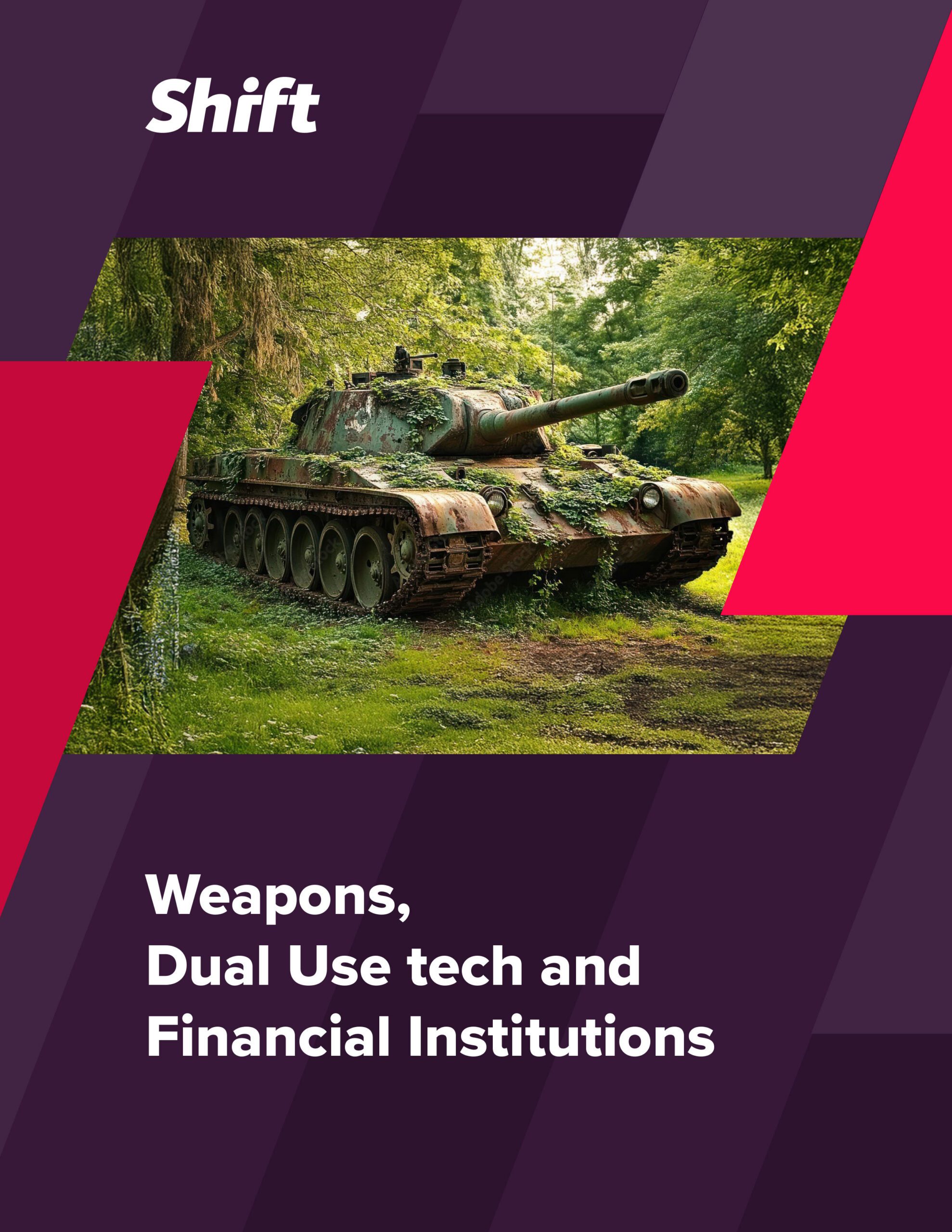
Defense Briefing Paper
A practical exploration of challenges and approaches for financial institutions navigating exposure to weapons and dual-use technology against a backdrop of intensifying conflict, fluid geopolitical alliances, and weakening adherence to international law.
Tips for Improving Social Peformanace Measurement
Eight tips to help financial institutions improve their approach to measuring social performance developed through Shift’s work with banks, insurers and investors.
Downstream Financial Institution Due Diligence, with DIHR and BSR
A compendium of examples, including six in-depth case studies, of how banks, investors, and insurers are embedding HRDD into their governance frameworks, operational processes, and financing activities.
Approaches to leverage in project finance, with the Equator Principles Association
A suite of due diligence tools designed to enhance access to grievance mechanisms and enable effective remedy in project finance transactions.
Managing Human Rights Risks: What Data Do Investors Need?
Four key areas for improving the quantity and quality of information accessible to investors seeking to understand and address how portfolio companies manage human rights risks within their operations and value chains.

Responsible Exit, with the CAO of the IFC
Landscape study exploring approaches to responsible exit amongst financial and non-financial actors to support the advancement of responsible exit practices for investment institutions.
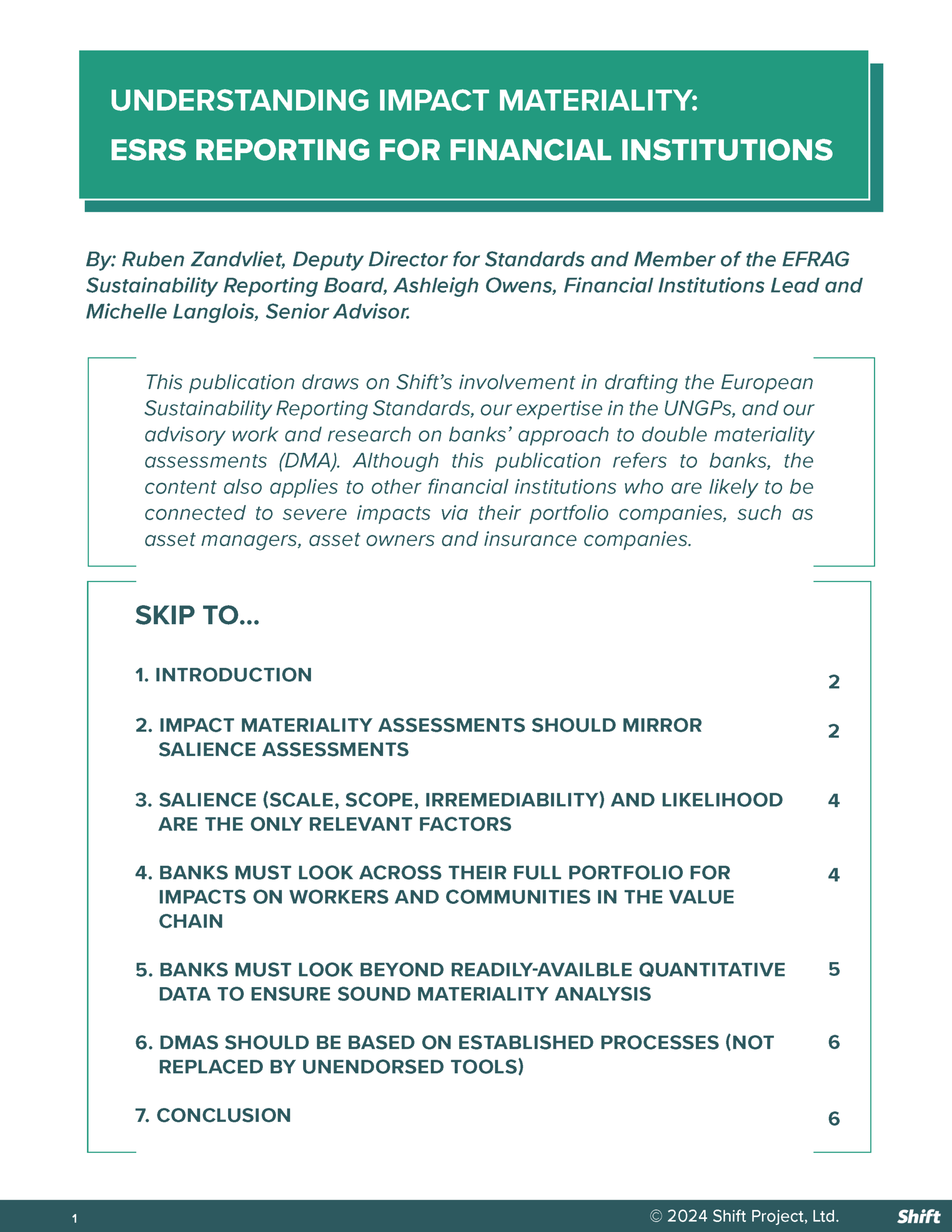
Understanding Impact Materiality
ESRS Reporting for Financial Institutions: Clarifying guidance for banks to ensure that their CSRD Double Materiality Assessments adequately meet EU reporting requirements by leveraging the underlying international standards on corporate respect for human right.
Testimonials /

Part of Just Climate’s mission is to scale climate solutions that work for the planet as well as people. Shift helped us close the gap between that ambition and what we actually do in diligence. Their work gave us sharper tools for identifying human rights risks earlier in the process – particularly in complex geographies like Brazil and India – and a clearer framework for thinking about our responsibilities when those risks sit in a company’s value chain rather than its direct operations. It has made us better investors.”
Clara Barby CBE / Senior Partner – Just Climate
Shift helped us substantially in building up fundamental knowledge across the organization. Our partnership has given us confidence that we are on the right track to become the best-in-class for implementing the UNGPs”
Rui Chang / Advisor Responsible Investment – PGGM Investments
Shift’s FIs Circle has allowed us to explore and discuss some of the challenges we face as we are implementing our corporate responsibility to respect human rights, along with our sector peers. Supported by valuable insight from Shift experts, this enables us to come up with outside-of-the-box ideas and solutions to continue to enhance our human rights due diligence process, advance leading practice in this space and contribute to better outcome for people.”
Anne-Élisabeth Piché / Export Development Canada
The topic you have presented is extremely fascinating, and we appreciated the passion you have in such a sensitive cause. You generated a lot of interest in the crowd and definitively passed the message on having to improve our work on the human rights front.”
Investment Bank