

The Problem with How we Measure Business Respect for Human Rights
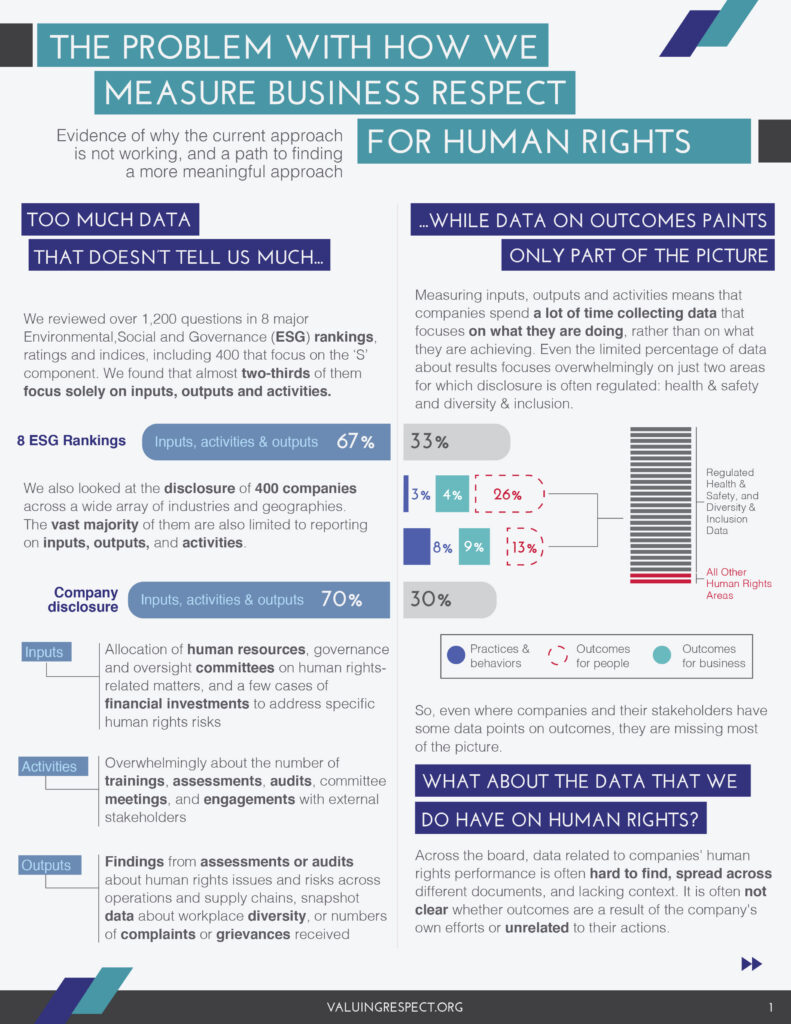
We reviewed over 1,200 questions in eight major Environmental, Social and Governance (ESG) rankings, ratings and indices, including 400 that focus on the ‘S’ component. We found that almost two-thirds of them focus solely on inputs, outputs and activities.
The Use of Metrics in Human Rights Reporting in the Food and Beverage Sector
This document summarizes the findings of an analysis that reviewed the human rights disclosure of fourteen companies in the food and beverage sector. It was performed in collaboration with the Fordham University Law Clinic.
The Current Use of Metrics in Company Human Rights Reporting in Southeast Asia
As part of our regional analysis of the use of metrics, we gathered data from the top 50 market capitalized companies in Malaysia, Singapore and Thailand, totaling 150 companies.
The Use of Metrics in Human Rights Disclosure in the Extractives and Oil Equipment Sector
We reviewed the disclosure of 25 extractives and oil equipment companies to better understand the types of indicators that are used and how meaningful they are to investors and other stakeholders
The Use of Metrics in Company Human Rights Reporting in Poland
As part of our regional analysis of the use of metrics, we gathered data from 107 companies including the top 100 companies by market cap listed on the Warsaw Stock Exchange at the end of 2017.
The Use of Metrics in Company Human Rights Disclosure in the ICT Sector
As part of the industry-level research that we conducted to understand how current metrics are used, we reviewed the disclosure of 12 companies in the sector of information and communications technology (ICT). This publication reports on our findings…
The Current Use of Metrics in Company Human Rights Reporting South Africa
For this report, the Centre for Human Rights at the University of Pretoria reviewed the non-financial reports of the top 100 companies (by market capitalization) listed on the Johannesburg Stock Exchange
Evaluating Business Respect for Human Rights: A Theory of Change Methodology to Develop Meaningful Indicators
In this piece, we discuss our Theory of Change methodology, and why it’s such a valuable tool for evaluating business respect for human rights.
An Analysis of ESG Rankings, Ratings and Indices
This document provides a deeper look into the analysis that we conducted of 1,200 questions in 8 major Environmental, Social and Governance (ESG) rankings, ratings and indices, including 400 that focus on the ‘S’ component.
Engaging Affected Stakeholders: Evaluating the Quality of Processes for Company-Community Engagement
In this paper, Shift Advisor Lloyd Lipsett describes the best questions to ask and the best practices to use when evaluating your company’s engagement with affected stakeholders.