

Leadership and Governance Indicators of a Rights Respecting Culture /
About the Indicators /
22 Practices and Behaviors that Help Foster Business Respect for Human Rights
Overview
This resource provides a menu of indicators of leadership and governance that can help to evaluate a company’s progress towards building a rights-respecting culture. It is not necessary to use all the indicators. They are intended as a menu from which organizations can draw as appropriate to their needs and contexts.
The primary intended users of the resource are:
- Business leaders seeking to assess the strengths and weaknesses of their company leadership, governance and culture with regard to respect for human rights.
- Investors and civil society organizations seeking to strengthen their analysis, strategies and engagement with companies regarding progress towards respect for human rights.
Connecting to Culture
Indicators of leadership and governance typically focus on formal systems – codes of conduct, organizational structures, roles, responsibilities and incentives. Evidence of these can signal how things should happen in an organization. But they miss the profound influence that the actions of governing bodies and senior leaders’ can have on what actually happens, through the day-to-day decisions and behaviours of people across the organization that determine its impact on employees, workers, communities and consumers.
The indicators in this resource are grounded in four features of a corporate culture that are central to respect for human rights:
- Authenticity such that the organization acts in a manner consistent with publicly asserted commitments to respect human rights, including when faced with inevitable tensions between respect for human rights and other business goals.
- Accountability such that respect for human rights is embraced as the responsibility of people in every part of the business, and key staff are empowered and motivated to embed respect for human rights across the company.
- Empathy such that everyone in the organization is motivated to know and care about whether and how it might be involved with harm to the human rights of people, including to remote individuals and communities.
- Organizational Learning such that everyone seeks out and embraces new insights about human rights risks and makes an effort to learn from mistakes as well as successes.
Resource Structure /
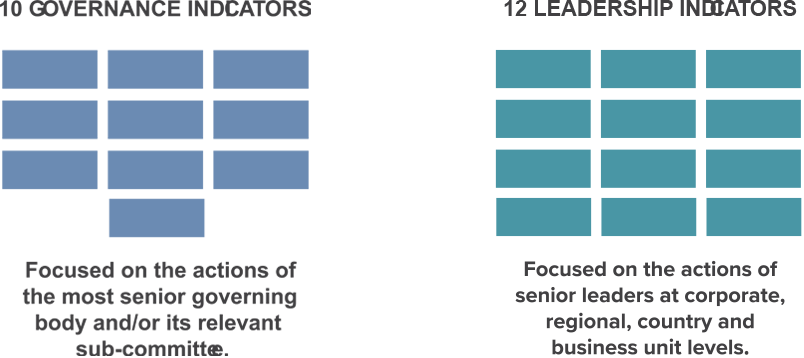
There are a total of 22 indicators, divided into two categories:
To see an overview chart with all 22 indicators, click Here
And each indicator is organized into three levels:
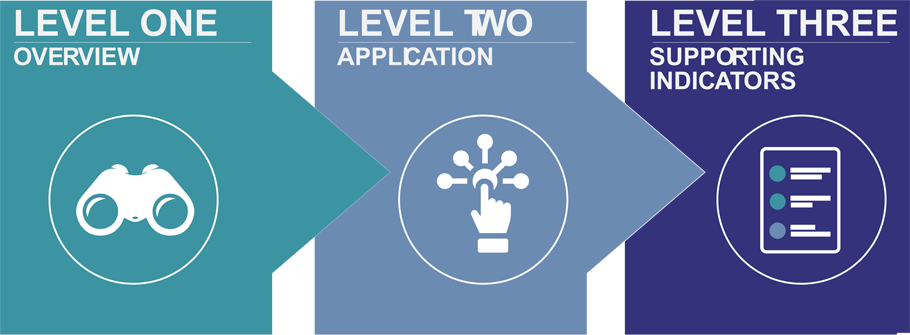
Level One: Overview
This includes:
- Explanation or an overview of the indicator and its relevance for embedding organizational behaviors, and robust due diligence practices that support respect for human rights;
- Key Questions for leaders to ask or be asked to aid initial analysis of whether the governance or leadership practice is present in the organization; and
- Connection to Culture that shows the link back to features of a rights-respecting culture.
Level Two: Application
This discusses:
- Types of Application highlighting the types of use, whether inside a company or by those outside a company, to which this indicator particularly lends itself; and
- Sources of Evidence signaling where information related to the indicator might be found, whether in documentation or by soliciting the perspectives of stakeholders.
Level Three: Supporting Indicators
The insight gained from using a single indicator in isolation – however well designed – will have its limits. These limits typically arise from assumptions behind the indicator, for example about pre-existing knowledge, motivations or the practices of others. Users can therefore validate the insight offered by an indicator by combining it with one or more others that address those assumptions. This section provides guidance on which indicators can be used in combination to meet this aim.
How to use this resource /
There are 10 Governance Indicators and 12 Leadership Indicators. You may use the purple bar below to filter them by each of the four features of corporate culture: authenticity, empathy, accountability and organizational learning. Hover over the “i” next. to each indicator to preview its full title. Once you’ve picked the ones you want to download, select them by clicking on the circled number of each indicator and choose ‘Download All Selected’. You may also choose to download the full series or to download a high level menu. To learn more about how each Indicator is structured, please see this page. For support, please contact communications@shiftproject.org.
To select multiple documents to download, click on the circles on the right.
- Filter By Sector :
G1
Reviews company’s business model
G2
Discusses progress and challenges
G3
Reviews coherence of lobbying
G4
Seeks views from across the workforce
G5
Seeks views from external affected stakeholders
G6
Ensures cross-functional collaboration
G7
Request and reviews root cause analysis
G8
Ensures positive performance incentives are in place
G9
Challenges negative performance incentives
G10
Approves high-level targets
Governance Indicators /
The Most Senior Governing Body
and/or Its Relevant Sub-Committees…
Leadership Indicators /
Senior Leaders at Corporate, Regional,
Country, and Business Unit Levels…
L1
Affirm commitment; discuss challenges and opportunities
L2
Promote and model treating people with respect and dignity
L3
Seek insights and critique from experts
L4
Seek views from across the workforce
L5
Seek views from external affected stakeholders
L6
React constructively to allegations
L7
Champion internal human rights leads
L8
Avoid pressures on people to not respect rights
L9
Support raising of questions and concerns
L10
Praise positive, and call out negative, actions
L11
Collaborate to address systemic issues
L12
Support learning from progress and setbacks