

The Proving Ground: What Asia Tells Us About the Enduring Relevance of the UNGPs /
By Dr. Harpreet Kaur*
September 10, 2026
International frameworks are adopted all the time.
Some influence policy debates for a few years before fading from view. Others remain largely within the communities that created them, discussed in conferences, reports and academic circles but never quite escaping them.
Fifteen years after their endorsement, the UN Guiding Principles on Business and Human Rights (UNGPs) have followed a different trajectory. They continue to shape legislation, investor expectations, business practices and public policy discussions around the world.
As we mark the fifteenth anniversary of the UNGPs, much of the discussion understandably focuses on what they have achieved. Yet an equally important question is why they succeeded where many earlier efforts to establish international standards and expectations for business conduct struggled to gain comparable traction. The question matters because the UNGPs did not emerge into an empty field. Attempts to define the responsibilities of business, and to address business-related harms through international norms, have a much longer history.
Asia offers an important part of the answer.
The Baseline of Change /
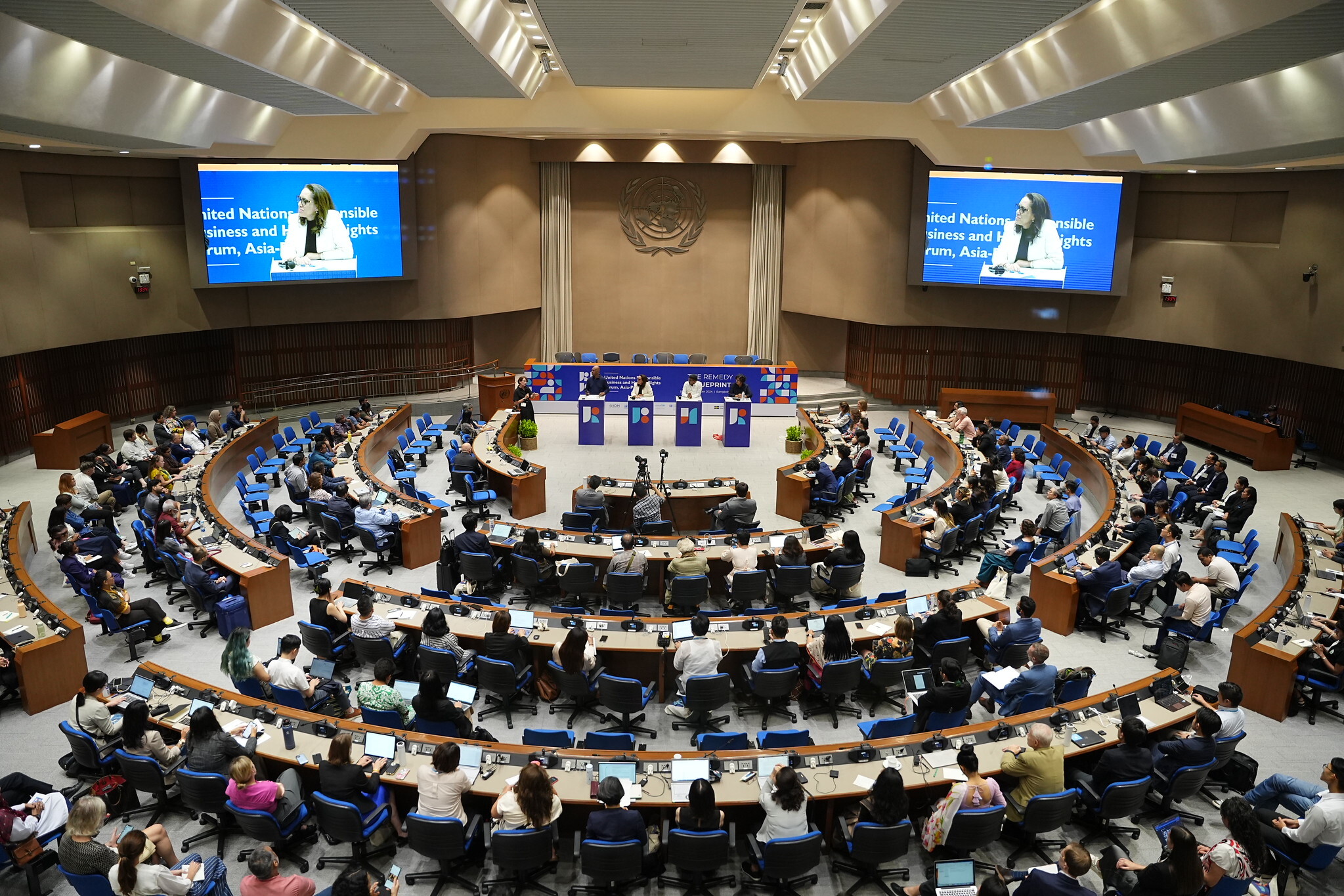
My introduction to the UNGPs came at the Asia consultation convened by the late Professor John Ruggie in New Delhi in 2009, less than a year after the Human Rights Council endorsed the “Protect, Respect and Remedy” Framework. Business and human rights was still a relatively niche conversation in much of Asia. Most companies were more familiar with corporate social responsibility (CSR) than human rights due diligence (HRDD), and governments rarely discussed business-related human rights impacts in a systematic way. Few would have predicted that within fifteen years governments across the region would be adopting National Action Plans (NAPs), debating mandatory HRDD, or embedding business and human rights within discussions on trade, investment, climate transition and economic governance.
Looking back, what strikes me is not simply how much remains to be done, but how easy it is to underestimate how much has changed. We often compare today’s reality against our ultimate aspirations rather than against the baseline from which it emerged. By that measure, the UNGPs will always appear unfinished. No framework, voluntary or mandatory, can by itself resolve the structural inequalities, governance failures and power imbalances that underpin many business-related human rights harms.
The more meaningful test is whether the UNGPs changed the terms of the debate, and whether that shift altered policy, practice and expectations of accountability.
In Asia, the answer is unequivocally yes, even if the depth and consequences of that change remain uneven.
Why did the UNGPs in Asia? /
Asia encompasses some of the world’s largest economies alongside some of its smallest. It includes major manufacturing hubs, resource-rich economies, rapidly expanding digital markets and countries preparing for graduation from least developed country status. Political systems, legal traditions and regulatory capacities vary enormously. Development priorities differ. So too do assumptions about the relationship between markets, states and society.
If there was a region where a universal framework would have been expected to struggle, it was Asia. The challenge was not diversity alone. Across much of the region, business and human rights emerged alongside rapid industrialisation, export-led growth and deep integration into global markets. Questions around labour rights, land, environmental protection, civic space and participation were often negotiated within broader national development priorities, while the operating environment for civil society and human rights defenders remained constrained in several jurisdictions.
Against this backdrop, the diffusion of the UNGPs was far from guaranteed. International frameworks often struggle when they encounter diversity; the challenge is greater when countries differ not only in their institutions and levels of development, but also in how they understand the problems a framework seeks to address.
The adaptability of the UNGPs offers an important clue. The proliferation of NAPs across countries as different as Japan, Thailand, Nepal, Indonesia, Malaysia, Mongolia, Pakistan and Viet Nam suggests that the strength of the UNGPs lies not in prescribing a rigid model, but in offering a common normative framework that can be translated into different political, economic and institutional realities. Countries entered the agenda through different pathways. In Thailand, momentum emerged through the National Action Plan process and is increasingly reflected in discussions around mandatory HRDD. In Malaysia, concerns around migrant workers and forced labour risks in key export sectors provided a crucial entry point. In Indonesia, conversations around natural resources, land rights and environmental governance increasingly intersected with business and human rights discussions. Japan’s engagement was shaped in part by corporate governance and global supply chains. In Nepal and Pakistan, trade relationships and sourcing expectations became increasingly important drivers.
The framework also travelled through business itself. The corporate responsibility to respect human rights did not depend on governments first closing regulatory or governance gaps; it placed a responsibility directly on companies to identify and address their human rights impacts. Asia’s deeply interconnected production networks created a need for common expectations that could travel across supply chains, business relationships and jurisdictions, even where national policy reform moved more slowly. The UNGPs provided companies operating across those different contexts with a common framework for doing so.
If the UNGPs have travelled further than many earlier efforts to establish international standards for business conduct, it may be because they combine a common normative foundation with considerable room for adaptation in how that foundation is put into practice. This flexibility is often portrayed as a structural weakness. Yet the Asian experience suggests it may also be one reason the Principles endure as a viable blueprint for action. Rather than prescribing a single model of implementation, they provide a common normative compass across very different political, economic and institutional realities.
The Principles establish a shared direction of travel and a common reference point, without requiring countries to follow the same route.
What does fifteen years of implementation tell us? /
Looking back, the Asian experience reveals several distinct dynamics that have shaped the agenda’s diffusion across the region.
1. Legitimacy preceded scale
The defining achievement of the first phase was not immediate, sweeping implementation at scale. It was establishing legitimacy.
When the UNGPs were endorsed in 2011, business and human rights remained peripheral to economic decision-making across much of the region. Few government ministries considered it part of their mandate; businesses largely viewed it as a niche concern, investors rarely engaged with it, and universities rarely taught it. Legitimacy, however, was not an end in itself. It gave governments, businesses and civil society a basis from which to act.
That legitimacy was being built just as the context around it was changing profoundly. By the middle of the decade, many Asian countries were beginning to engage through National Action Plans and responsible business initiatives. Today, the agenda extends into debates on mandatory human rights due diligence, sustainability reporting, climate transition, supply-chain resilience and environmental governance. The persistence of the UNGPs across these different moments suggests that their significance lies not in offering fixed answers to changing problems, but in providing a framework through which new challenges can be understood and acted upon.
Seen through this lens, National Action Plans also look somewhat different. They are often evaluated by the policies they produced or failed to produce. Yet their significance may also lie in what happened around the documents themselves: governments became more familiar with the agenda, institutional focal points emerged, capacities developed, and business and human rights acquired greater legitimacy as an area of public policy. Across Asia, NAP processes also became important vehicles for peer learning, allowing governments to learn from one another’s experiences, adapt approaches to local contexts and build confidence to act.
2. Socialisation often preceded regulation
An important part of the UNGPs’ diffusion in Asia occurred through relationships and peer learning, alongside more formal processes of policy adoption. Governments learned from other governments. National Human Rights Institutions exchanged experiences. Businesses looked to peers for ways to improve their practices. Regional and subregional forums brought together actors with divergent interests, creating spaces where ideas could be contested, translated and, over time, normalised. In doing so, they helped build trust across different constituencies and socialise norms that had previously been unfamiliar or contested. Their significance was not simply that they raised awareness. They helped actors interpret what an international framework meant within their own political, economic and institutional contexts. In this sense, the spread of the UNGPs was not simply a process of policy adoption. It was also a process of socialisation.
3. Integration mattered more than isolation
Business and human rights gained traction when it stopped being seen as a stand-alone agenda. In much of Asia, governments and businesses did not engage substantively because of abstract debates about corporate responsibility. They did so when the framework intersected with issues they were already grappling with: trade competitiveness, supply-chain resilience, migrant worker protections, ESG reporting, responsible investment and environmental governance. As priorities changed, the points of entry for action changed too. Yet the underlying framework remained relevant.
But institutionalisation is not the same as impact. Access to remedy remains one of the weakest areas of implementation across much of Asia, and for workers and communities already experiencing harm, this is perhaps where the legitimacy of the framework encounters its hardest test. The challenge of scale is equally apparent in reaching beyond large companies to the SMEs that underpin many Asian economies and supply chains, and to informal workers who often remain outside formal systems of protection. Women, migrants, Indigenous Peoples and other vulnerable groups continue to experience disproportionate risks.
The success of the UNGPs should therefore not be measured solely by the institutions created, policies adopted or commitments made. Ultimately, it must be judged by whether those efforts translate into better outcomes for people.
The Frontier: Navigating Systemic Trade-offs /
The first fifteen years of the UNGPs in Asia were largely about establishing legitimacy and building foundational institutions. The next phase will demand something far more complex: navigating profound systemic trade-offs.
Many of the defining business and human rights challenges of our time are increasingly concentrated in Asia. Critical minerals, renewable energy supply chains, labour migration, digital technologies, artificial intelligence, climate adaptation and shifting trade relationships are no longer emerging issues. They are reshaping economies across the region today, often bringing competing rights, development priorities and economic interests into much sharper tension.
This is happening at a curious moment. Commitments to climate action, sustainability and human rights are facing growing political headwinds in some parts of the world, yet momentum continues to emerge across parts of Asia. Discussions on mandatory human rights due diligence are advancing in countries such as Indonesia and Thailand. Malaysia has increased attention to forced labour and migrant worker protections. ASEAN institutions are engaging more actively with questions at the intersection of business, human rights and environmental sustainability.
This should not be romanticised. Progress remains uneven, implementation gaps remain significant, and many communities continue to experience serious harms. But the direction of travel is noteworthy. The growing engagement of ASEAN is particularly significant, because it suggests that the agenda is increasingly being interpreted through regional priorities and institutions rather than remaining primarily an externally driven conversation.
The harder questions now lie in what happens when these agendas collide. How should governments and businesses pursue renewable energy expansion while protecting land rights and ensuring meaningful participation? How should countries balance competitiveness with worker protections? What responsibilities accompany growing demand for critical minerals? How should human rights considerations shape the development of artificial intelligence and digital economies?
These are not uniquely Asian questions. But many of them are increasingly being negotiated in Asia. And unlike the earlier challenge of establishing whether business and human rights belongs within economic decision-making at all, these questions require choices about whose interests are prioritised, who bears the costs of economic transformation, and whose voices shape the decisions.
The first fifteen years tested whether the UNGPs could travel across one of the world’s most diverse regions and acquire the legitimacy to become a vehicle for change. The next fifteen will test something harder: whether that legitimacy can translate into changes in business practice, accountability and, ultimately, outcomes for affected people.
* Dr Harpreet Kaur is UNDP’s Asia-Pacific lead on Business and Human Rights, working with governments, businesses, investors, civil society and rights-holders across 17 countries. An anthropologist by training, she brings over two decades of experience across multilateral institutions, civil society, academia and media. At the forefront of UNGP implementation in Asia, she has shaped regional policy processes and advanced practical approaches to human rights due diligence and meaningful stakeholder engagement. Her expertise lies in building trusted coalitions and steering cross-sector initiatives through complex environments, with gender equity and meaningful participation at the heart of her approach. Harpreet served on the World Economic Forum’s Global Future Council on Human Rights and and holds academic affiliations with universities in Europe and Asia-Pacific.