

Measuring Quality of Relationships: Using ICMM’s “Understanding Company-Community Relations” Toolkit
While the need for good relationships between companies and their host communities is widely recognized, there is very little clarity on how to assess if a company is achieving this goal.
Cultivating Voice in Relationships: Using Regular Micro-surveys at Scale to turn Stakeholder Experience and Perceptions into Actionable Data
This note profiles Constituent Voice (CV): a way to engage and learn from large numbers of people about how company, government and funders’ programs and activities impact them.
Using Experiments to Assess Behavior Change Interventions
Using Randomized Control Trials (RCT) that integrate the perspectives of affected stakeholders to assess company-driven behavior interventions.
Sensemaker: Combining Stories, Numbers and Data Analytics to Uncover Hidden Dimensions of Relationships
Collecting “micronarratives” from large and diverse populations of affected workers or communities – then visualizing patters to reveal insights about their experiences.
Using Worker Voice Tools to Assess Relationships Between Workers and their Managers
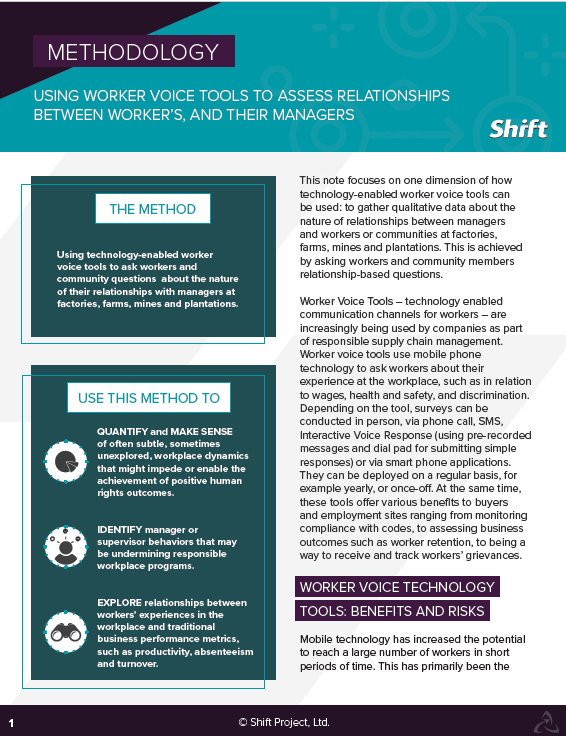
This note focuses on one dimension of how technology-enabled worker voice tools can be used: to gather qualitative data about the nature of relationships between managers and workers or communities at factories, farms, mines and plantations.
Using Relationship Data to Improve Business Practices: Measuring Company-Community Relationships at a South African Mine
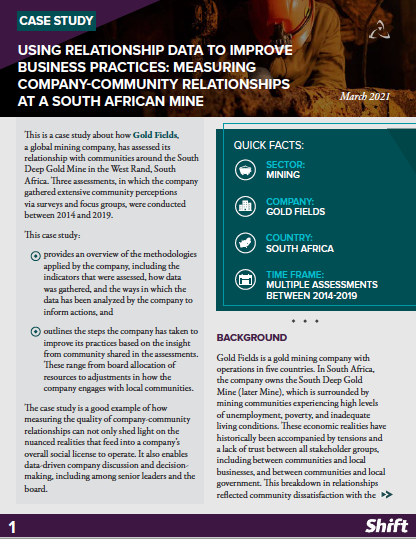
This is a case study about how Gold Fields, a global mining company, has assessed its relationship with communities around the South Deep Gold Mine in the West Rand, South Africa.
Evaluating Child Labor Programs: Uncovering How Local Norms Impact Field-Level Relationships Between Farmers, Workers and Children
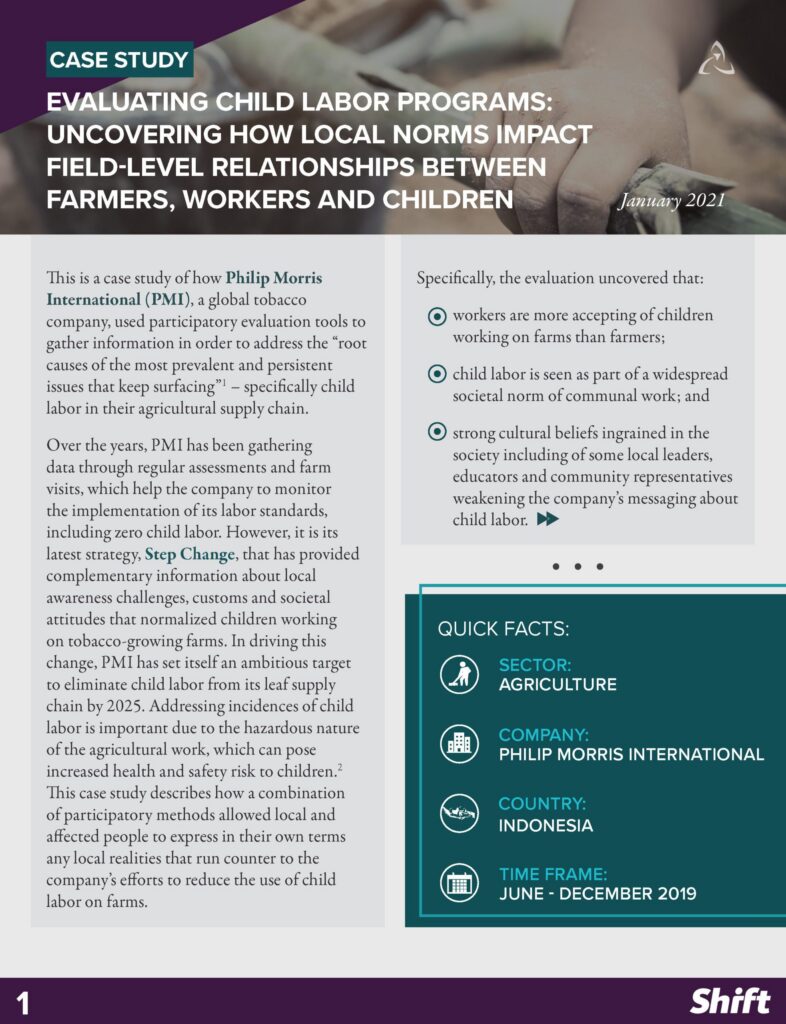
This is a case study of how Philip Morris International (PMI), used participatory evaluation tools to gather information in order to address the “root causes of the most prevalent and persistent issues that keep surfacing” – specifically child labor in their agricultural supply chain.
Assessing whether Behavior Change Training can Improve Relationships Between Supervisors and Workers
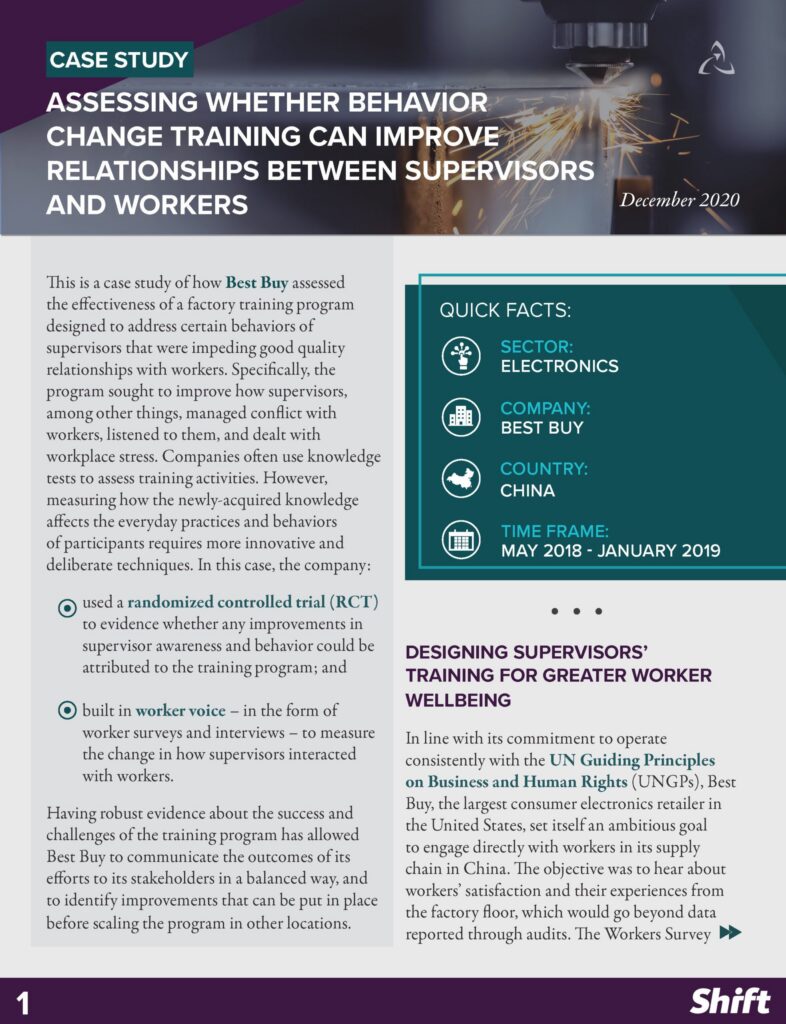
Assessing whether Behavior Change Training can Improve Relationships Between Supervisors and Workers / Download This is a case study of how Best Buy assessed the effectiveness of a factory training program designed to address certain behaviors of supervisors that were impeding good quality relationships with workers. This is a case study of how Best Buy assessed the […]
Stakeholder Voice: Learning from Affected Stakeholders to Better Evaluate Program Effectiveness and Outcomes
In this piece, Shift Advisor Jana Mudronova explores ways to involve the voices of affected stakeholders in the evaluation of company efforts to mitigate adverse human rights impacts.
Engaging Affected Stakeholders: Evaluating the Quality of Processes for Company-Community Engagement
In this paper, Shift Advisor Lloyd Lipsett describes the best questions to ask and the best practices to use when evaluating your company’s engagement with affected stakeholders.