

Red Flag 5. Algorithmic decision-making that can result in discrimination

Algorithmic decision-making to profile, and make predictions about, people in ways that can result in discrimination or other human rights harms.
Red Flag 4. Privatized access to public goods with risks to quality of services
The business’s commercial success substantially depends upon offering privatized access to public goods and services, such as water, health, security and housing, where profit-maximization affects
access or quality
Red Flag 2. High-speed that places pressure on warehouse workers and logistics workers in “the last mile”
Offering high-speed delivery such that it places pressure on warehouse workers and logistics workers in the “last mile”.
Red Flag 3. Project timelines that undermine consultation with communities
The business’s commercial success substantially depends upon construction or commencement of projects with timelines that do not allow sufficient time for consultation with groups affected by the projects.
Beyond Pride Series
Beyond Pride Series / // Back to Resources
Red Flag 1. Offering lowest cost goods or services in ways that put pressure on labor rights
The business’s commercial success substantially depends upon offering lowest cost goods or services such that it becomes economically challenging for the company or suppliers to respect labor rights.
Measuring Quality of Relationships: Using ICMM’s “Understanding Company-Community Relations” Toolkit
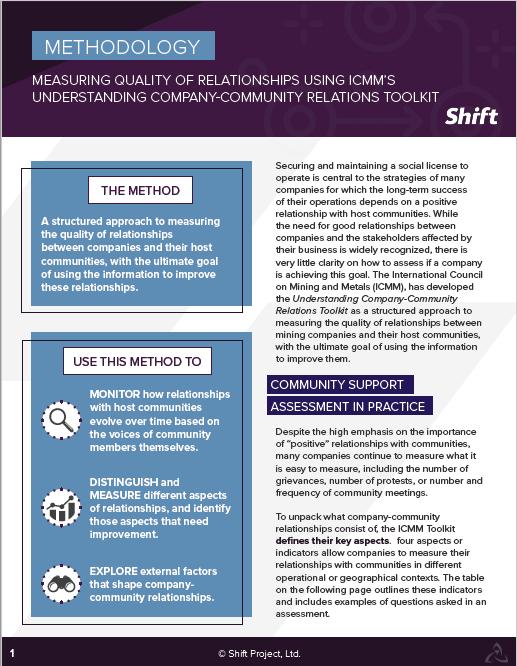
While the need for good relationships between companies and their host communities is widely recognized, there is very little clarity on how to assess if a company is achieving this goal.
Cultivating Voice in Relationships: Using Regular Micro-surveys at Scale to turn Stakeholder Experience and Perceptions into Actionable Data
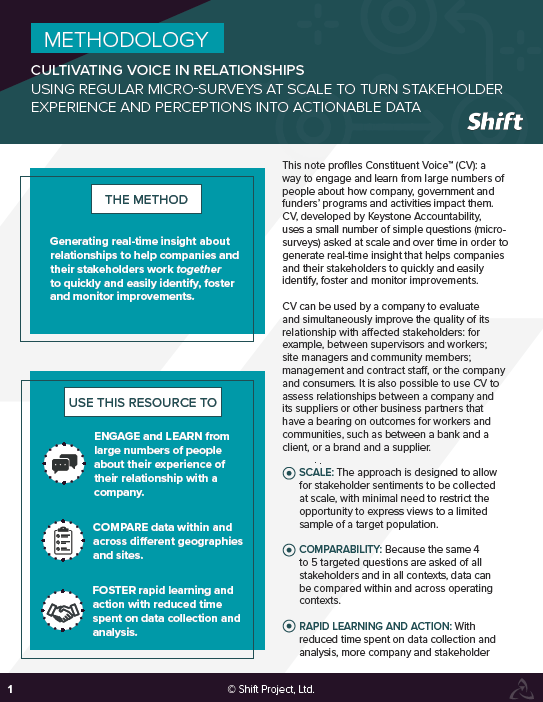
This note profiles Constituent Voice (CV): a way to engage and learn from large numbers of people about how company, government and funders’ programs and activities impact them.
Using Experiments to Assess Behavior Change Interventions
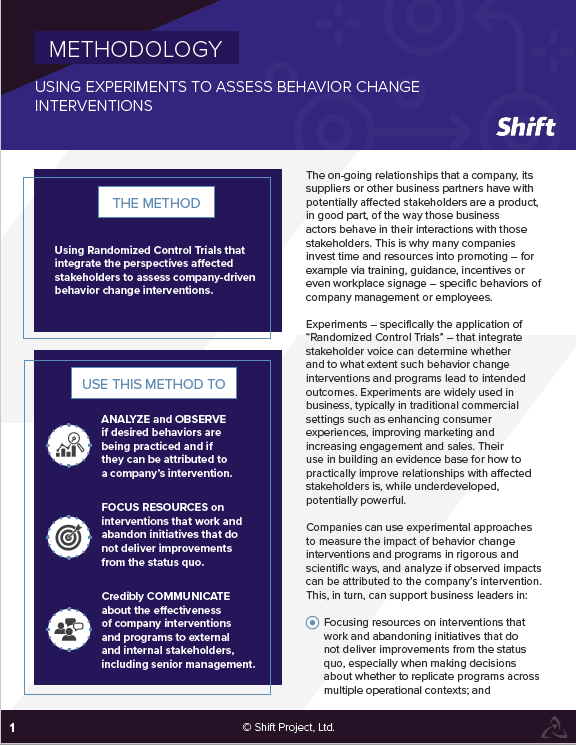
Using Randomized Control Trials (RCT) that integrate the perspectives of affected stakeholders to assess company-driven behavior interventions.
Sensemaker: Combining Stories, Numbers and Data Analytics to Uncover Hidden Dimensions of Relationships
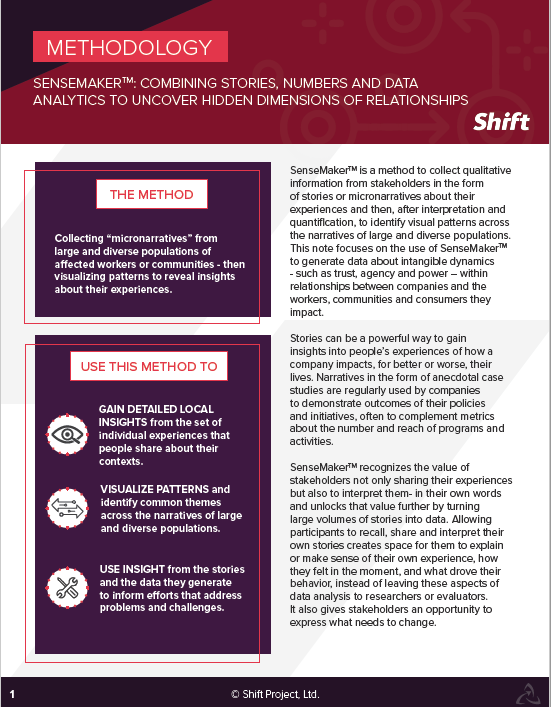
Collecting “micronarratives” from large and diverse populations of affected workers or communities – then visualizing patters to reveal insights about their experiences.